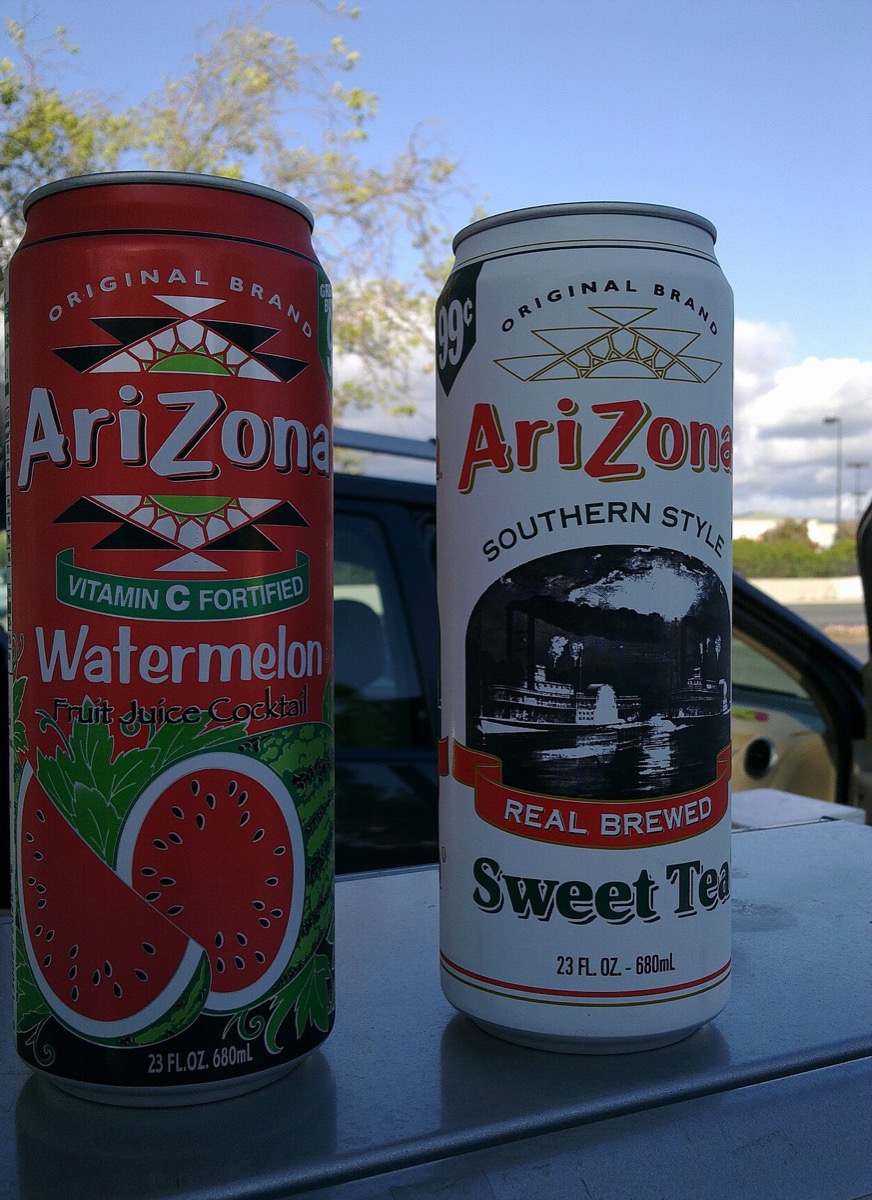
Ask when AriZona’s tall can got its 99¢ and you get three years. The company’s website says it printed the price on the can in 1996. Its co-founder, Don Vultaggio, was reported in 2022 as saying 1997, and said 1998 in a 2024 interview. Our own AriZona entry said “the mid-90s” until today.
So we went looking for things printed at the time: a store’s newspaper ad from 1993, a magazine story from 1996, and the company’s own website as it stood in 2003, which the Internet Archive keeps. None of them dates the printed price. They do show what the can cost and how big it was, and both have a longer history than the usual line, that the can has cost 99 cents since 1992.
The short version: We found nothing printed in the 1990s that says when the 99¢ went onto the can, so the year rests on the company’s word (1996) and on its co-founder’s, who has been reported saying 1997 and quoted saying 1998. What is on paper: a Michigan store advertised the 24-ounce can at 99¢ in February 1993, and the can has since been listed at 23.5 ounces, printed at 23, and is 22 today.
This article is built from published sources. Nobody here handled a 1990s can.
The three years given for AriZona’s 99¢ can
Swipe the table sideways to see every column.
| Year given | Who gives it | What it says |
|---|---|---|
| 1996 | AriZona, on its own website | "When we printed 99¢ directly on our Big Cans in 1996, it was a visible commitment to value, one that would shape every decision we made from that point forward." |
| 1996 | Los Angeles Times (Sam Dean, April 12, 2022) | "AriZona has been committed to 99 cents since 1996, when it started printing the price directly on cans to stop retailers from raising prices on their own." |
| 1997 | Nexstar (Alix Martichoux, August 28, 2022) | "The prominent 99-cent price label was added to the colorful designs of AriZona's 23-ounce drink cans in 1997, founder Don Vultaggio said." |
| 1997 | The New York Times (Remy Tumin; republished by Boston.com on August 10, 2025) | "He introduced the 99-cent tallboy in 1997." |
| 1998 | Don Vultaggio, to Retail Brew (September 27, 2024) | "In 1992 we started, but we didn't have a price on a can. In 1998 with the price on the can, when we did it, people said [customers] are not gonna like it." |
We read each of these on November 19, 2026: the Times article in the copy that Boston.com republished, and the Nexstar report on WAVY.com, one of its stations’ sites. The bracketed word in the last row is Retail Brew’s.
All three news reports quote Vultaggio. The Los Angeles Times’s 1996 and The New York Times’s 1997 are the reporters’ own sentences, and neither says where its year came from. The New York Times’s 1997 is for “the 99-cent tallboy”; the printing comes in its next paragraph, with no year. Nexstar attributes its 1997 to Vultaggio, in a paraphrase. The only year he gives for the price on the can in his own quoted words is 1998.
What the AriZona can cost in 1993, from a store’s ad
The oldest price we found is in The Romulus News, a newspaper in Romulus, Michigan, a suburb of Detroit. On page 4 of its issue of February 10, 1993, a store called Golden Gallon advertised “ARIZONA ICED TEA 24-OZ. CAN” at 99¢. The same ad offers a four-pack of the 24-ounce cans for $2.89, in “5 FLAVORS”.
That is nine months after the company’s own timeline puts the first can on sale, in May 1992. Detroit was one of AriZona’s first strong markets: a business directory from the late 1990s says 80 percent of the brand’s 1993 sales came from New York, New Jersey, Miami and Detroit.
Forbes described the pricing in its issue of August 26, 1996: “To make their tea stand out, Ferolito and Vultaggio packaged it in a tall, 24-ounce can that was clearly bigger than Snapple’s 16-ounce bottle. With both priced at 99 cents, Arizona was a bargain.” John Ferolito was Vultaggio’s partner, and Snapple was the brand they were chasing. The Los Angeles Times said the same in 2022: “When Vultaggio started out, Snapple also charged 99 cents for its signature 16-ounce glass bottles.”
By the Bureau of Labor Statistics’ inflation calculator, 99 cents in February 1993 is $2.33 in October 2026 dollars.
When AriZona’s can cost more than a dollar, by its co-founder’s account
Many recent accounts say the price has never moved. CNBC wrote in 2024 that it “hasn’t gone up even a penny in the 32 years since” 1992, and the Los Angeles Times called 99 cents “the same price it has been since it hit the market 30 years ago”.
Vultaggio’s own account, as The New York Times reported it in 2025, is different. At a time of worry over the supply of aluminum, “AriZona raised the price of its canned iced tea above $1. Sales immediately took a sharp hit, Vultaggio said.” Then, “as aluminum prices eased”, he “introduced the 99-cent tallboy in 1997. By 2000, he said, sales were up 30%.”
The Times places the increase “Just as AriZona was hitting the market”. That sits oddly with the 1993 ad and with Forbes, which both have the can at 99 cents in the brand’s first years, so the timing is not settled.
A reference book from the late 1990s points the same way. The International Directory of Company Histories, in a volume catalogued as 1999 whose account of the company stops in late 1998, says sales slipped in 1996 and adds: “FV&S’s totals would have looked worse, according to a Newsday article, if the company had not raised prices sharply and introduced new superpremium-priced flavors.” FV&S is Ferolito, Vultaggio & Sons, the company’s name at the time. The only Newsday article in the directory’s reading list is dated April 7, 1997.
We have not read that Newsday article, and we did not find a store ad with the can above a dollar. So we cannot say what the higher price was or which months it covered.
If Vultaggio’s account is right, the 99¢ on the can was not simply the launch price with a label on it: the price had been higher in between. The Times adds that stores did not like it at first: retailers “initially bristled at Vultaggio’s insistence on printing” the price on the can, “locking the company into that price.”
When some AriZona cans went out without the 99¢, by a 2009 trade column’s account
The printed price has not been on every can since, either. A column in the July-August 2009 issue of BevNET Magazine, a beverage trade publication, says: “For a brief period over the past year, as critical materials like aluminum and corn syrup surged in price, the company had to hedge its reliance on the tactic, putting some cans into the market without the 99-cent price and launching a 20 oz. plastic-bottle line prepriced at $1.” It adds that “as soon as prices subsided, the company went back to prepricing all its big cans.”
The column is bylined to BevNET’s staff online, and its author note names Gerry Khermouch, “executive editor of Beverage Business Insights”. It is written in the first person and gives no source for that episode, so it rests on the columnist’s word.
The same column calls pre-pricing the cans at 99 cents “a tactic detested by retailers for constraining their register ring but hard to question for its effectiveness”. It is the oldest account of the printed price that we found, and it does not say when the tactic began.
What AriZona’s own 2003 timeline says about the can
The Wayback Machine holds copies of the company’s old website, arizonabev.com, from 1998 on. A page headed “A BRIEF HISTORY OF ARIZONA”, captured on August 4, 2003, lists the company’s milestones by month. Its first entry, dated May 1992, reads: “AriZona introduced in 24-ounce can. Later that year the product also packaged in 20-ounce bottles.”
The list goes on to the first green tea (July 1996), a plastic “Sport Can” (May 1997) and designer packages by the artist Peter Max (May 1998), and it ends in September 2002. It has no entry for a price on the can, and the word “price” is not in it.
So the nearest thing to a company record from those years is silent on the question. Of the statements that give a year, the oldest we found is the Los Angeles Times’s, from 2022.
The 2009 column has the can prepriced by then, and the photograph at the top of this page shows the flag itself. Its file data dates it May 9, 2010, and the white Sweet Tea can has a flag reading 99¢ at its top.
How big the AriZona can has been: 24, 23.5, 23 and 22 ounces
Swipe the table sideways to see every column.
| Size | When | Where it is recorded |
|---|---|---|
| 24 ounces | 1992 and 1993 | The company's timeline, in its entry for May 1992 ("AriZona introduced in 24-ounce can"), and the Golden Gallon ad of February 10, 1993 ("24-OZ. CAN") |
| 23.5 ounces | 2002 and 2003 | The company's timeline has an Arnold Palmer drink introduced in August 2002 "in 23.5-ounce Big Can"; its Green Tea product page, captured on February 18, 2003, lists a "23.5 oz CAN" |
| 23 ounces | 2009 and 2010 | The 2009 BevNET column describes "the 23 oz. “big boy” AriZona Iced Tea can". Printed on the cans in the photograph above: the Sweet Tea reads "23 FL. OZ. - 680mL", and the Watermelon gives the same two figures |
| 22 ounces | By January 2023, to today | Vultaggio to Yahoo Finance, January 13, 2023: "The 23-ounce can is now 22 ounces." AriZona's store listed its green tea as a "22 oz. Big Can" on November 19, 2026 |
We did not find when the can stopped being 24 ounces, or when cans began to read 23. We also could not confirm that “23.5” was ever printed on a can: 23.5 fluid ounces is about 695 milliliters, and the cans in the 2010 photograph say 680.
The last change has a stated reason. In the same Yahoo Finance interview Vultaggio said: “We changed the can lid in order to save some aluminum.” The Los Angeles Times was still describing “a giant 23-ounce can” in April 2022. Nexstar’s report of August 28, 2022, which calls the cans 23-ounce in its sentence about 1997, mentions a lid change without saying the can got smaller: “They’ve also made a change to their cans’ lids, using less aluminum and making them lighter.”
Later accounts often give the first can a different size. Retail Brew’s introduction to its 2024 interview says “the 99-cent, 23 oz. Big Can” was introduced in 1992, and Today.com wrote that in 1992 “a 23-ounce can of Arizona iced tea was 99 cents”. The 2009 BevNET column has AriZona launching in “the 23.5 oz. big boy beer cans familiar to them from the malt liquor business”. The 1993 ad and the company’s own timeline both say 24.
At 99 cents, the 24-ounce can worked out to about 4.1 cents an ounce, and the 22-ounce can works out to 4.5.
What we could not read
- Newsday, April 7, 1997. The one Newsday story in the directory’s reading list, and so the likely source of its line on the price increase. We know it only through that listing.
- Anything printed between 1996 and 2000 about the price going onto the can. We searched the Internet Archive’s scanned magazines and newspapers and found none. That is a statement about what the search turned up, not proof that nothing was printed.
What we changed in our AriZona entry
Our AriZona Iced Tea entry said the price “has been 99 cents since 1992” and that printing it on the can began “in the mid-90s”. It now carries the 1993 ad, Vultaggio’s account of the price going above a dollar, all three years given for the 99¢ can, and the four can sizes.
Sources
- Why is AriZona Iced Tea Still 99¢? · AriZona Beverages
- A BRIEF HISTORY OF ARIZONA (the company's timeline, as captured August 4, 2003) · AriZona Beverage Co., via the Internet Archive's Wayback Machine
- Green Tea product page, with its list of package sizes (as captured February 18, 2003) · AriZona Beverage Co., via the Internet Archive's Wayback Machine
- Green Tea | 22 oz. Big Can (product page, read November 19, 2026) · AriZona Beverages
- The Romulus News, February 10, 1993 (Golden Gallon advertisement, page 4) · The Romulus News, Romulus, Michigan, via the Internet Archive
- Just call us cockroaches (Daniel Roth, August 26, 1996; the story begins on page 58) · Forbes, via the Internet Archive
- A chat with AriZona co-founder Don Vultaggio at the brand's AriZonaLand experience (Erin Cabrey, September 27, 2024) · Retail Brew
- The New York Times' 2025 feature on Don Vultaggio and AriZona (Remy Tumin), as republished by Boston.com on August 10, 2025 · The New York Times, republished by Boston.com
- How is AriZona Iced Tea still 99 cents as inflation soars? (Sam Dean, April 12, 2022) · Los Angeles Times
- A Brief History Of Arizona (a column in BevNET Magazine, July-August 2009; bylined BevNET.com Staff, with an author note naming Gerry Khermouch; posted August 15, 2009) · BevNET
Show all 18 sources Show the first 10 only
- AriZona iced tea is still 99 cents. In this economy, how is that possible? (Alix Martichoux, Nexstar Media Wire, August 28, 2022) · WAVY.com
- Ferolito, Vultaggio & Sons (from the International Directory of Company Histories, volume 27, catalogued as 1999) · Encyclopedia.com
- AriZona raises bottle prices by 25% to keep iconic cans at 99 cents (Brooke DiPalma, January 13, 2023) · Yahoo Finance
- Why AriZona Iced Tea CEO won't raise 99-cent price: 'It's my little way of giving back' (Nicolas Vega, CNBC, June 27, 2024) · CNBC Make It, republished by NBC 7 San Diego
- Arizona Iced Tea founder on why he's kept the 99-cent price tag: 'We're successful' (Alex Portée; first published April 19, 2022, updated June 27, 2024) · Today.com
- CPI Inflation Calculator ($0.99 in February 1993, in October 2026 dollars) · U.S. Bureau of Labor Statistics
- File:Arizona drinks.jpg (photograph dated May 9, 2010) · Wikimedia Commons
- Romulus, Michigan · Wikipedia
In this article

AriZona Iced Tea
1992–present
The Big Can: a tallboy of iced tea wrapped in pastel southwestern art that looked like nothing else in the cooler. It came out of a Brooklyn warehouse in 1992 to fight Snapple, priced at 99 cents — a number the company later started printing on the aluminum itself, and has all but refused to let go of since, through decades of inflation.

Snapple
1972–present
The iced-tea and juice-drink brand that defined 1990s refreshment, served in a distinctive glass bottle with a metal cap (the famous "Real Facts" printed under the lid didn't arrive until 2002). That satisfying pop when you opened it, the quirky trivia, and flavors like peach and raspberry made Snapple a generational memory.