The Hitchhiker's Guide to the Galaxy (2005 film)

Don't panic. Douglas Adams' radio-born comedy about the last man to survive Earth's demolition finally reached theaters in April 2005, after more than two decades of false starts, with Martin Freeman in the dressing gown, Sam Rockwell as a two-headed galactic president, and Alan Rickman as the voice of a very depressed robot.
The Hitchhiker's Guide to the Galaxy began as a BBC Radio 4 sitcom that ran for two series between 1978 and 1980, then became a novel in 1979, a BBC television series in 1981 and a text adventure game in 1984. A film was talked about almost from the start. Adams turned down early approaches in the 1970s because he feared the studios wanted "Star Wars with jokes," then signed an option in 1982 with producers Ivan Reitman, Joe Medjuck and Michael C. Gross and wrote three scripts for them. Dan Aykroyd pitched Reitman a different story in the meantime, and that project became Ghostbusters. The rights were sold in 1997 to Caravan Pictures, which became Spyglass Entertainment, and the film went quiet again.
Around 2001 director Jay Roach, using the clout of Austin Powers and Meet the Parents, secured a new deal with Adams through Disney, and Adams wrote a fresh script. Then, on 11 May 2001, Adams died. Roach brought in Karey Kirkpatrick to finish the screenplay from Adams' final draft and the notes he had left, and when Roach himself stepped back, Spike Jonze recommended Garth Jennings and Nick Goldsmith, the team known as Hammer & Tongs. Shooting wrapped in August 2004. The finished film carries a screenplay credit shared by Adams and Kirkpatrick and is dedicated to Adams.
It opened on 28 April 2005 in the UK, Europe, Australia and New Zealand, and a day later in the United States and Canada. Martin Freeman is Arthur Dent, the Englishman who wakes to find first his house and then his planet scheduled for demolition; Mos Def is his alien friend Ford Prefect, Sam Rockwell the newly elected President of the Galaxy Zaphod Beeblebrox, Zooey Deschanel the Earth woman Trillian, Bill Nighy the planet builder Slartibartfast and John Malkovich Zaphod's rival Humma Kavula. Stephen Fry narrates as the Guide itself, Helen Mirren voices the supercomputer Deep Thought, and Alan Rickman voices Marvin the depressed android while Warwick Davis wears the suit. The Vogons were built by Jim Henson's Creature Shop, and Simon Jones, the original radio and TV Arthur, turns up in a cameo. Earth is destroyed to make way for a hyperspace bypass, the answer is still 42, and a whale and a bowl of petunias still fall out of the sky.
The film opened at number one in North America and finished with a little over $104 million worldwide, with mainly positive reviews that still divided between those who found it faithful in spirit and critics who found it heavier-footed than the source. Freeman later said Jennings told him it had not done well enough to earn a sequel. What it did do was send a new wave of readers back to the books.
Similar items
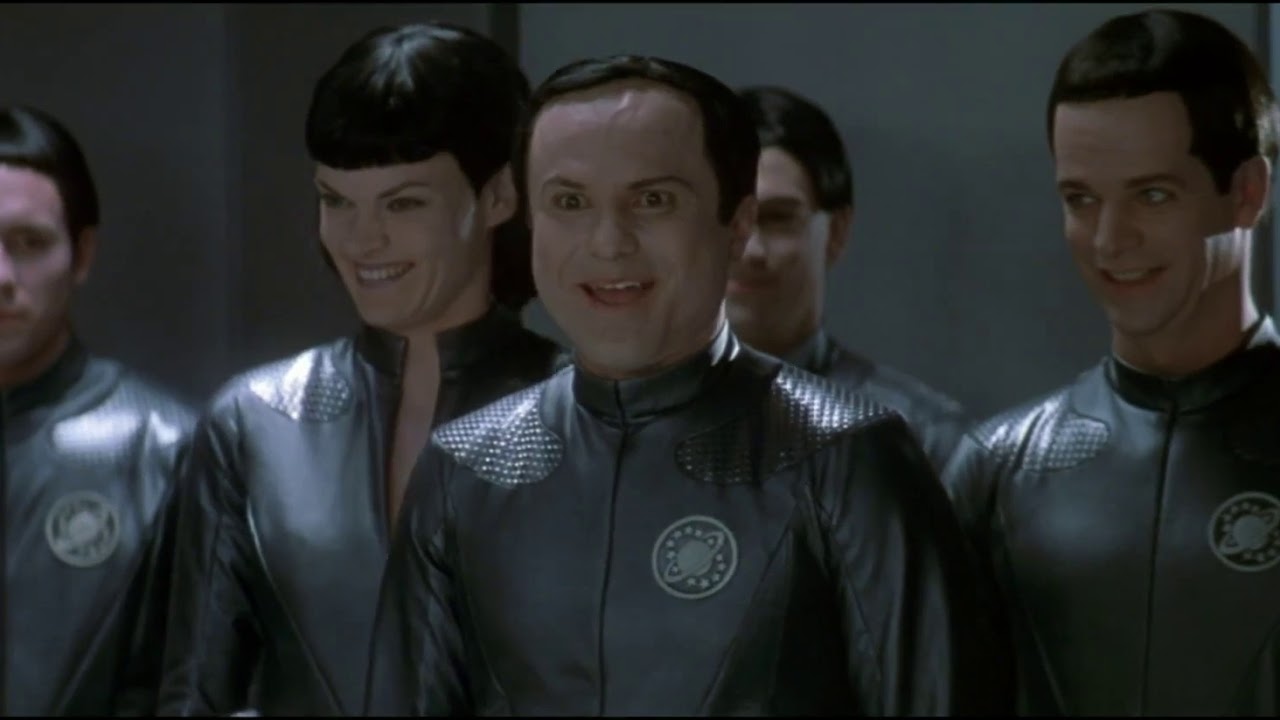
Galaxy Quest
The washed-up cast of a canceled space show gets abducted by aliens who watched the reruns and thought they were documentaries. "Never give up, never surrender!" The Star Trek parody so good that actual Trek fans voted it one of the best Star Trek films — and it isn't one.

Shaun of the Dead
A London sales advisor stuck in a rut and his slacker best mate face the zombie apocalypse armed with household objects, a vinyl collection, and a plan that begins and ends at the pub. Edgar Wright and Simon Pegg's "rom-zom-com" is the parody so precise and so affectionate it stands as a great zombie film in its own right — Romero himself phoned to say so.

Men in Black
Will Smith and Tommy Lee Jones in black suits and shades, policing the aliens already living in Manhattan. The neuralyzer flash, the talking pug, and a theme song you could not escape made this one of the defining blockbusters of summer 1997.

Romy and Michele's High School Reunion
Two best friends, one Tucson reunion, and the lie that they invented Post-its. Mira Sorvino and Lisa Kudrow in 1997, with a dance number Roger Ebert called "the weirdest choreography I have seen outside a 1960s revival." A modest hit in theaters that became a sleepover classic on tape and cable.